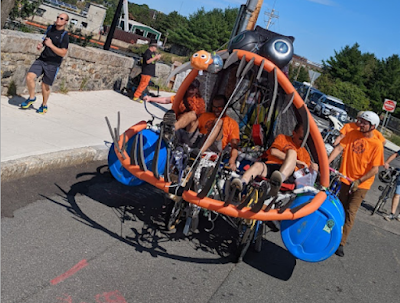
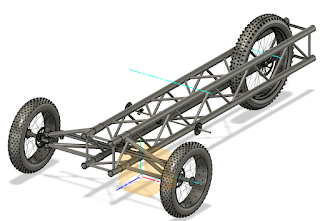
It was a slog. Designing all the parts. Making all the parts. Installing all the parts. It was a lot. But it was all for that moment, the glorious Lowell Kinetic Sculpture Race 2025. We worked hard to get the Falcon ready. We actually had time to do some testing, which was already a win for us. 😜 Each test revealed flaws that had to be addressed. Some small. Some big, race-ending issues.
The First Test
The big idea we had for this race was to be able to change the ride height between the obstacles and the road. We’d be able to ride low and fast on the street and create more space between us and the mud/water. I designed a lever geometry held together with a large tension rod.
For the first test, I rolled out of the garage and turned the handlebars, testing the steering. It turned with relative ease. I then grabbed the brake handle and pulled. It worked great, but the handle was difficult to reach from the seat. A small problem.
I repurposed one of the rear forks from a small, junked bike frame and fashioned it into longer brake handle. The length of the handle also increased the leverage we could apply. Now the brake handle was easy to reach and easy to apply.
A bigger problem then revealed itself.
As I rolled forward, the front wheels seemed to come out of their bearings. Again. This seemed to be the same thing that ended our race last year! End of Test 1. After a lot of review, I discovered that the problem wasn’t coming from the wheel bearings. It was a whole new problem.
The culprit was the giant tension rod holding the suspension together. Its movement was not restricted, so, on unlevel terrain, the tension rod moved sideways, twisting the axles out of their bearings. I needed to lock the tension rod in place somehow. This was tricky. The tension rod moves up and down about an inch between its lowest and highest settings. So the bracket had to keep the rod from moving laterally but still allow it to slide up and down.
I think I had kind of expected this issue, because I already had a solution in mind. I drew up a special bracket the next day and made them on the Tormach.
The front, vertical cross member of the truss and a parallel threaded rod acted as rails for the bracket. The tension rod poked through a hole on the side of bracket to reach the levers.
The Second Test
Our second test was actually filmed for a documentary about our struggles!
This content is blocked because it would connect to YouTube.
We rode up and down our block for an hour, filming our tests, until Andee’s chain broke. That convinced me to reduce the size of the main sprocket between the pilots gears and the Falcon gears. This would slow us down, but it would reduce the forces going through the bicycle chains. That change would have to wait. There were still issues with the front wheels.
We had arrested the lateral movement in the tension rod, and that worked great. However, whenever there was a dip in the road, the wheel would still twist out of its bearing. It wasn’t as bad as before, but it was still significant.
I needed a better way to lock the wheels in place. I remembered that there was a spacer between the axle and the wheel hubs. It’s only purpose had been to fill in the extra space between the smaller diameter axle and the larger diameter hub. I remade it into a flanged collar. Instead of just being buried inside the hub, a large flange on the back of the collar would “catch” any residual racking in the wheels.
I fabricated the flanges on the Tormach, the tubes on the lathe, and welded all the pieces together.
Our tests had also revealed that the bolts securing the axle bearing plate still stuck out too much. Any misalignment between the wheel and knuckle would catch a bolt head on the brake disc. I countersunk the mounting holes in the bearing plates and switched to flathead bolts to attach them. This ensured that the wheel always spun regardless of the its camber.
While installing the new flanged collars, I damaged the threads on one of the front axles. I fixed it with a grinder but I also shortened the axle too much. The mating bolt could no longer reach the axle threads, so I had to make a longer one.
The Water Test (Test #3)
In 2024, we bought a 6 person whitewater raft to use as our flotation. We cut the back and bottom out, wrapping the raft around the Falcon and spreading the sides out to form a stabilizing triangle.
When we switched from seats to bike frames, the pedals moved lower than last year, so we had to push the side pontoons out further to make room. I was good with that. It would just make us more stable in the water. I used an 8 foot steel tube to span the distance between the pontoons.
We drove out to a boat dock on the Merrimac River and unloaded the Falcon. I pedaled it down to the boat dock. This was also the first time we tested the upgrades we made all week. After a few cranks of the pedal, we felt confident enough to go into the water.
We positioned the raft in front of the boat ramp, inflated the pontoons, and secured the raft to the frame.
The first issue immediately revealed itself. When we fully inflated the front pontoon, it rubbed up against the tires, acting like a brake. 🤦♂️I’d address that later. In the meantime, we let just out enough air that we could move. Then we carefully entered the water. And we floated!
Our feet were in the water, but we figured it would sit a little taller once we could inflate all the way. We entered the water too slowly, so the rear tires didn’t clear the boat ramp. I jumped off to unbeach us. Then we floated. Hurray! We still needed some kind of fender to keep the sides of the raft away from the wheels, but we could float.
The Next Road Test
The fourth test proved the anti-rack collars were a good upgrade. There was still a little wobble in the front tires, but it was very much improved. We were able to turn without the wheels seizing up. Every crank of the pedal moved us forward.
We noticed the front and rear chains skipped a tooth whenever we tried to pick up speed. The chains need to be tightened, but that was a small problem. Then we noticed the rear chain seemed to tighten and loosen while we pedaled. This was not a tension problem.
The driveshaft between the pilots deformed from the forces generated through the pedals. The chain engaged and disengaged as the sprocket orbited unnaturally around the driveshaft. I would have to make a new driveshaft and if I was doing that I decided to also address another problem.